Fake 'Invoice' SPAM - delivers Locky and Trickbot
- https://myonlinesecurity.co.uk/malware-delivered-via-necurs-botnet-by-dde-feature-in-microsoft-word/
19 Oct 2017 - "Another change from the Necurs botnetdelivering Locky and Trickbot again today with an email with the subject of 'Emailed Invoice – 459572' (random numbers) pretending to come from random names at your own email address or company domain…
They have changed to using word docs again but they are -not- using macros but using the DDE “exploit” or feature which -allows- linked files. These are very similar to embedded ole objects but instead of the object
(normally a script file) being embedded in the word doc & you clicking it to allow it to run, these link to a remote website without you seeing the link. This link describes it in better detail:
> https://blog.barkly.com/microsoft-office-malware-attack-no-macros
One of the emails looks like: From: Stacie Osborne
Date: Thu 19/10/2017 11:15
Subject: Emailed Invoice – 459572
Attachment: I_459572.doc
Body content:
As requested
regards
Stacie Osborne …
I_459572.doc - Current Virus total detections 9/60*. Payload Security**
The word doc uses this DDE “feature” to contact (in this example, there will be loads of others)
http ://alexandradickman .com/KJHDhbje71 where a base64 encoded file is opened and decoded.
This has 3 hardcoded URLS inside it (again there will be others in other examples)
“http ://shamanic-extracts .biz/eurgf837or”,
”http ://centralbaptistchurchnj .org/eurgf837or”,
”http ://conxibit .com/eurgf837or” which gives a txt file which is -renamed- to rekakva32.exe
(VirusTotal 6/65[3]) (Payload Security[4])… The basic rule is NEVER open any attachment to an email, unless you are expecting it…"
* https://www.virustotal.com/en/file/ea132c34ebbc591eda78531e2bfb9a4cb40e55a245191f54e82df25be9b58db2/analysis/1508408047/
Fake 'eFax' SPAM - delivers Trickbot
- https://myonlinesecurity.co.uk/more-fake-efax-messages-deliver-trickbot-banking-trojan/
19 Oct 2017 - "An email with the subject of 'eFax' pretending to come from eFax service but actually coming from a whole range of look-a-like domains with a malicious word doc attachment is today’s latest spoof of a well-known company, bank or public authority delivering Trickbot banking Trojan… the criminals sending these have registered various domains that look-like genuine Company, Bank, Government or message sending services…
efax190238535-34522.doc - Current Virus total detections 4/59*. Payload Security**
This malware file downloads from
http ://acupuncturenorthwest .com/kas47.png which of course is -not- an image file but a renamed .exe file that gets renamed to Fcd-4.exe (VirusTotal 12/64[3]). An alternative download location is
http ://www.agcofruit .com/kas47.png
This email attachment contains a genuine word doc with a macro script that when run will infect you.
The word doc looks like:
> https://myonlinesecurity.co.uk/wp-content/uploads/2017/10/efax190238535-34522_doc.png
… DO NOT follow the advice they give to enable macros or enable editing to see the content… The basic rule is NEVER open any attachment to an email, unless you are expecting it…"
* https://www.virustotal.com/en/file/f89e1c298bd162716e62906e1dca9b1353d0162788f1db9ceb5daed8f3f9d30c/analysis/1508420918/
Locky Ransomware’s Recent SPAM
- http://blog.trendmicro.com/trendlabs-security-intelligence/look-locky-ransomwares-recent-spam-activities/
Oct 19, 2017 - "… A closer look at Locky’s activities reveals a constant: the use of spam. While spam remains to be a major entry point for ransomware, others such as Cerber also employ vectors like exploit kits. Locky, however, appears to concentrate its distribution through large-scale spam campaigns regardless of the variants released by its operators/developers… We’ve also found how the scale and scope of Locky’s distribution are fueled by the Necurs botnet, a spam distribution infrastructure comprising zombified devices. It churns out a sizeable amount of spam emails carrying information stealers like Gameover ZeuS, ZBOT or Dridex, and other ransomware families such as CryptoLocker, CryptoWall, and Jaff. Necurs is Locky’s known and long-time partner in crime, and it’s no coincidence that the surge of Locky-bearing spam emails corresponds with the uptick in Necurs’ own activity. In fact, we saw that Necurs actively pushed Locky from August to October:
> https://blog.trendmicro.com/trendlabs-security-intelligence/files/2017/10/locky-spam-2.jpg
It’s also worth noting that Necurs also distributed Locky via URL-only spam emails — that is, the messages didn’t have -any- attachments, but rather -links- that divert users to -compromised- websites hosting the ransomware. The use of HTMLs embedded with -links- to the -compromised- site also started gaining traction this year… the continuous changes in Locky’s use of file attachments are its way of adjusting its tools to evade or bypass traditional security. But despite the seeming variety, there are common denominators in Locky’s social engineering, particularly in the email subjects and content. They appear to have the same old flavors, but with relatively different twists. Some of the recent lures we saw were:
- Fake voice message notifications (vishing, or the use of voice-related systems in phishing attacks)
- HTML attachments posing as invoices
- Archive files masquerading as business missives from multinationals, e.g., audit and budget reports
- Fraudulent emails that involve monetary transactions such as bills, parcel/delivery confirmations, and payment receipts…" (More detail at the trendmicro URL above.)
Today's crop of cyber criminal attempts to INFECT systems and PC's through E-mail gets WORSE. 'Best bet is to read these posts by "good-guy" analysts and get what you can from their research, however convoluded the criminals means have evolved, and remember the standard warnings for ALL E-mail that hits your Inbox:
"DO NOT follow the advice they give to enable macros or enable editing to see the content.
The basic rule is NEVER open any attachment -or- link in an email, unless you are expecting it."
Necurs Botnet malspam pushes Locky using DDE attack
- https://isc.sans.edu/forums/diary/Necurs+Botnet+malspam+pushes+Locky+using+DDE+attack/22946/
2017-10-19 - "… the DDE attack* technique has spread to large-scale distribution campaigns…"
* https://www.bleepingcomputer.com/news/security/microsoft-office-attack-runs-malware-without-needing-macros/
___
Alert (TA17-293A)
Advanced Persistent Threat Activity Targeting Energy and Other Critical Infrastructure Sectors
- https://www.us-cert.gov/ncas/alerts/TA17-293A
Oct 20, 2017 - "Systems Affected:
Domain Controllers
File Servers
Email Servers
Overview: This joint Technical Alert (TA) is the result of analytic efforts between the Department of Homeland Security (DHS) and the Federal Bureau of Investigation (FBI). This alert provides information on advanced persistent threat (APT) actions targeting government entities and organizations in the energy, nuclear, water, aviation, and critical manufacturing sectors. Working with U.S. and international partners, DHS and FBI identified victims in these sectors. This report contains indicators of compromise (IOCs) and technical details on the tactics, techniques, and procedures (TTPs) used by APT actors on compromised victims’ networks…
DHS assesses this activity as a multi-stage intrusion campaign by threat actors targeting low security and small networks to gain access and move laterally to networks of major, high value asset owners within the energy sector. Based on malware analysis and observed IOCs, DHS has confidence that this campaign is still ongoing, and threat actors are actively pursuing their ultimate objectives over a long-term campaign. The intent of this product is to educate network defenders and enable them to identify and reduce exposure to malicious activity…" (More detail at the us-cert URL above.)
office_security_update.zip: Extracts to: ms_office_update.exe - Current Virus total detections 13/67*.
Payload Security**…
Update: after digging around the mail server quarantine, I have found several of these, coming via numerous different -compromised- email accounts. All of them have the same malformed content with no accessible attachment… The basic rule is NEVER open any attachment or link in an email, unless you are expecting it…"
* https://www.virustotal.com/en/file/7be8966df205b91f95f3c56ef972be0264b35c865450fb69b9861fd82748e69b/analysis/1508670171/
ms_office_update.exe
'BadRabbit' ransomware attacks…
> https://www.bleepingcomputer.com/news/security/bad-rabbit-ransomware-outbreak-hits-eastern-europe/
Oct 24, 2017 - "A new ransomware strain named 'Bad Rabbit' is wreaking havoc in many Eastern European countries, affecting both government agencies and private businesses alike. At the time of writing, the ransomware has hit countries such as Russia, Ukraine, Bulgaria, and Turkey. The speed with which Bad Rabbit spread is similar to the WannaCry and NotPetya outbreaks… ESET and Proofpoint researchers say Bad Rabbit has initially spread via -fake- Flash update packages, but the ransomware also appears to come with tools that help it move laterally inside a network, which may explain why it spread so quickly across several organizations in such a small time…"
Fake 'Invoice' SPAM - using 'DDE exploit'
- https://myonlinesecurity.co.uk/another-locky-ransomware-fake-invoice-malspam-campaign-using-dde-exploit/
24 Oct 2017 - "Another Locky ransomware campaign using the DDE exploit[1]…
1] https://www.bleepingcomputer.com/news/security/microsoft-office-attack-runs-malware-without-needing-macros/
… the word doc contains embedded -links- that use the DDE exploit to contact a remote server & get a base64 encoded string which decodes to a set of instructions to contact a list-of-urls in turn, until one responds…
Asking somebody to 'update links' seems innocent enough and many recipients will click 'yes': Update fields warning message from DDE exploit word doc:
> https://myonlinesecurity.co.uk/wp-content/uploads/2017/10/update-fields.png
… many of the intermediate stages and files never get stored or kept on the victim’s computer, in fact the final Locky binary is deleted as soon as it has been run, so there are few forensic artefacts for investigation. Brad Duncan has done a Blog post at ISC explaining all this in detail[2] with examples from the earlier run.
2] https://isc.sans.edu/forums/diary/Necurs+Botnet+malspam+pushes+Locky+using+DDE+attack/22946/
Invoice_file_921629.doc - Current Virus total detections 10/61*. Payload Security** | contacts
‘http ://transmercasa .com/JHGGsdsw6'
where it downloads to memory the base64 encoded string which decodes to give these 3 urls
http ://tatianadecastelbajac .fr/kjhgFG
http ://video.rb-webdev .de/kjhgFG
http ://themclarenfamily .com/kjhgFG
This delivers heropad64.exe (VirusTotal 51/67[3]) (Payload Security[4]) which in turn sends a post request with system fingerprints to
http ://webhotell .enivest.no/cuYT39.enc
where if the response is acceptable it then downloads the Locky ransomware file from that site in an encrypted text format and converts it to a working .exe. 6213Lq3p.exe (VirusTotal 8/67[5]).
It then autoruns it & deletes both the encrypted txt and the binary. It further contacts what looks like a C2 at
http ://gdiscoun .org …
… easy to protect against by changing 1 simple setting in Microsoft Word (provided your company does -not- use the DDE feature to dynamically update word files with content from Excel spreadsheets etc). See HERE for details:
… The basic rule is NEVER open any attachment to an email, unless you are expecting it…"
* https://www.virustotal.com/en/file/46bb448bd849212c1df99cae15984b669dc19cf16fb6ccb28b211a3d21b50f1d/analysis/1508840890/
Fake 'Scan Data' SPAM - delivers Locky via 'DDE exploit'
- https://myonlinesecurity.co.uk/locky-ransomware-delivered-via-dde-exploit-scan-data-malspam-no-replyvictim-domain/
24 Oct 2017 - "… Once again the word doc contains embedded links that use the 'DDE exploit' to contact a remote server & get a base64 encoded string which decodes to a set of instructions to contact a list of urls in turn, until one responds, to download a small file which in turn downloads the main Locky ransomware binary…
Fake 'Order acknowledgement' SPAM - malicious attachment
- http://blog.dynamoo.com/2017/10/malware-spam-order-acknowledgement-for.html
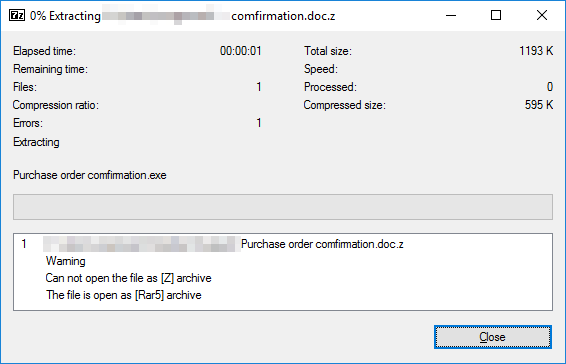
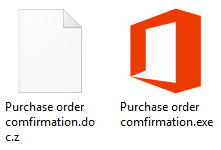
24 Oct 2017 - "A change to the usual -Necurs- rubbish, this -fake- order has a malformed .z archive file which contains a malicious executable with an icon to make it look-like an Office document: Reply-To: purchase@ animalagriculture .org
To: Recipients [DY]
Date: 24 October 2017 at 06:48
Subject: FW: Order acknowledgement for BEPO/N1/380006006(2)
Dear All,
Kindly find the attached Purchase order# IT/IMP06/06-17 and arrange to send us the order acknowledgement by return mail.
Note: Please expedite
the delivery as this item is very urgently required.
Regards, Raj Kiran
(SUDARSHAN SS) NAVAL SYSTEMS (S&CS;) …
Fake 'Quotation' SPAM - delivers malware
- https://myonlinesecurity.co.uk/fake-quotation-update-request-delivers-malware/
25 Oct 2017 - "… an email with the subject of 'Re: Quotation' pretending to come from SNG Equipment (in previous similar emails, the sender & companies mentioned in the email body were fairly random). I am not entirely sure what malware this is. Indications are it could be Lokibot… This file has an icon that makes it look like it is an Excel spreadsheet. Unless you have “show known file extensions enabled“, it can easily be mistaken for a genuine XLS spreadsheet instead of the .EXE file it really is, so making it much more likely for you to accidentally open it and be infected…
Fake 'Payment slip' SPAM - delivers Java Trojan
- https://myonlinesecurity.co.uk/fake-payment-slip-copy-malspam-delivers-java-trojan/
25 Oct 2017 - "… emails containing java Adwind, Java Jacksbot or other Java backdoor or Remote Access Trojans. We see these sort of emails frequently. Today’s has a slightly different subject and email content to many of the previous ones. This has a link-to-download-the-java-file rather than an attachment containing the malware…
The -link- hidden behind the image goes to
http ://www.system.air-alicante .eu/lib/css/Payment508879883.jar (519kb)
Current Virus total detections 1/62*. Payload Security**… system.air-alicante .eu looks to be a compromised Virtual Airline Site that appears to have been abandoned by its owner after a server crash. It was registered by Godaddy in July 2016 to a German Registrant. Currently hosted on 206.214.223.170 ServInt AS25847 which appears to be “owned” by a reseller fivedev .net who doesn’t have any abuse or contact details… The basic rule is NEVER open any attachment or link in an email, unless you are expecting it…"
* https://www.virustotal.com/en/file/4237d996cdfccb66f498b3f7e674fa0b185a7f812e1c2058b75f9eb0a89ea23c/analysis/1508882800/
Fake 'Payment Advice' SPAM - delivers malware
- https://myonlinesecurity.co.uk/fake-payment-advice-malspam-transferdept-com-delivers-malware/
25 Oct 2017 - "… an email with the subject of 'RE: Payment Advice 2000076579' (probably random numbers, although both copies I received have the same numbers) pretending to come from OFFICE . with an ACE file attachment (ACE files are a lesser known form of zip file that needs special programs to unzip them. A high proportion of recipients will -not- have this software on their commuter)… no idea what malware this actually is, although it is quite well detected on Virus Total as a generic malware…. As far as I can determine transferdept .com is a domain that is up for sale and has no website etc associated with it…
… The link-in-the-email goes to a -compromised- or fraudulently set up OneDrive for business/ SharePoint site where a zip file containing a .js file is downloaded. That eventually downloads the Dridex banking Trojan:
https ://tailoredpackaging-my.sharepoint .com/personal/bec_tailoredpackaging_com_au/_layouts/15/guestaccess.aspx?docid=0b5a1a2799b6e419daf97f646640e195b&authkey;=AduyYkbo5mf9IESLsGPE6yk
Fake 'TRANSFER PAYMENT ERROR' SPAM - delivers malware
- https://myonlinesecurity.co.uk/transfer-payment-error-urgent-attention-malspam-delivers-malware/
26 Oct 2017 - "… an email with the subject of 'TRANSFER PAYMENT ERROR (URGENT ATTENTION!!!)' pretending to come from OFFICE with an ACE file attachment (ACE files are a lesser known form of zip file that needs special programs to unzip them. A high proportion of recipients will not have this software on their commuter). Yesterday we saw a similar malspam campaign using the same-email details spoofing transferdept .com[1]… not sure what malware this actually is, although it is quite well detected on Virus Total as a generic malware. It is most probably Fareit trojan…
1] https://myonlinesecurity.co.uk/fake-payment-advice-malspam-transferdept-com-delivers-malware/
Fake 'account documents' SPAM - delivers Trickbot via DDE exploit
- https://myonlinesecurity.co.uk/fake-lloyds-bank-your-account-documents-deliver-trickbot-banking-trojan-via-the-dde-exploit/
26 Oct 2017 - "… using the DDE exploit[1] to perform malware campaigns… today the Trickbot gang have got in the act with an email with the subject of 'Your account documents' pretending to come from Lloyds Bank but actually coming from a look-a-like domain with a malicious word doc attachment is today’s latest spoof of a well-known company, bank or public authority delivering Trickbot banking Trojan…
1] https://www.bleepingcomputer.com/news/security/microsoft-office-attack-runs-malware-without-needing-macros/
Documents.docx - Current Virus total detections 4/58*. Payload Security**…
This malware docx file downloads from
http ://preview.tastymovies .com/moviefiles/lorangosor.png which of course is -not- an image file but a renamed .exe file that gets renamed to ect.exe (VirusTotal 12/67***)
Today’s example of the spoofed domain is, as usual, registered via Godaddy as registrar using privacy protection services.
lloydsbankdownload .com hosted on numerous servers and IP addresses and sending the emails via [removed] smtp3.wow-me .org | 95.211.213.219 | 185.2.81.3 | 213.152.162.231 | All of which are based in Netherlands… DO NOT follow the advice they give to enable macros or enable editing to see the content…
The basic rule is NEVER open any attachment or link in an email, unless you are expecting it…"
* https://www.virustotal.com/en/file/48115dc13a65640f433a4b584c5838b7173b08ea58e2ebba12dc23a10fe60c52/analysis/1509019722/
ec4b69380c33a9fa2b0145ed0b118ef2.doc
DO NOT follow the advice they give to enable macros or enable editing to see the content…
The basic rule is NEVER open any attachment or link in an email, unless you are expecting it…"
(More detail at the myonlinesecurity.co.uk URL above. )
Fake 'Invoice' SPAM - delivers Locky via word docs with embedded OLE objects
- https://myonlinesecurity.co.uk/blank-emails-with-fake-invoice-attachments-deliver-locky-ransomware-via-word-docs-with-embedded-ole-objects/
31 Oct 2017 - "… another change in the Necurs botnet malspam delivery that normally delivers Locky ransomware or Trickbot banking trojan. After a week or so of using the DDE exploit, today they have switched back to embedded-OLE-objects inside a word doc… The emails pretend to be invoices with a completely empty-blank-body… The word doc contains an embedded PowerShell -script- that runs when you follow their prompts to double-click-the-image. This contacts a remote server where it opens in memory (without saving to the disc in any obvious way) a set of instructions to contact a list-of-urls in turn, until one responds, to download a small file…
Invoice INV0000808.doc - Current Virus total detections 5/61*. Payload Security** contacts
http ://christakranzl .at/eiuhf384 where it downloads to memory a set of instructions that give
these 6 urls:
"http ://projex-dz .com/i8745fydd”,
“http ://celebrityonline .cz/i8745fydd”,
“http ://sigmanet .gr/i8745fydd”,
“http ://apply.pam-innovation .com/i8745fydd”,
“http ://bwos .be/i8745fydd”,
“http ://zahntechnik-imlau .de/i8745fydd”
… Using a UK based IP number, this delivered requ4.exe which is an old well known remote admin tool Netcat. (VirusTotal 48/67[3])… using a USA based IP via a proxy, I also got requ4.exe (from the same urls) but a totally different version that looks like Locky ransomware (VirusTotal 15/66[4]) (Payload Security[5])… DO NOT follow the advice they give to enable macros or enable editing to see the content… The basic rule is NEVER open any attachment to an email, unless you are expecting it…"
* https://www.virustotal.com/en/file/b510684253a4142aec0a3cf8f8bd13b551408917ac98cce6bde1a480ebc56532/analysis/1509442810/
Banking Trojan targets Google Search Results (SEO)
- http://blog.talosintelligence.com/2017/11/zeus-panda-campaign.html
Nov 2, 2017 - "It has become common for users to use Google to find information that they do not know. In a quick Google search you can find practically anything you need to know. Links returned by a Google search, however, are not guaranteed to be safe. In this situation, the threat actors decided to take advantage of this behavior by using Search Engine Optimization (SEO) to make their malicious links more prevalent in the search results, enabling them to target users with the Zeus-Panda-banking-Trojan. By poisoning the search results for specific banking related keywords, the attackers were able to effectively target specific users in a novel fashion. By targeting primarily financial-related keyword searches and ensuring that their -malicious- results are displayed, the attacker can attempt to maximize the conversion rate of their infections as they can be confident that infected users will be regularly using various financial platforms and thus will enable the attacker to quickly obtain credentials, banking and credit card information, etc. The overall configuration and operation of the infrastructure used to distribute this malware was interesting as it did not rely on distribution methods that Talos regularly sees being used for the distribution of malware. This is another example of how attackers regularly refine and change their techniques and illustrates why ongoing consumption of threat intelligence is essential for ensuring that organizations remain protected against new threats over time… The initial vector used to initiate this infection process does not appear to be email based. In this particular campaign, the attacker(s) targeted specific sets of search keywords that are likely to be queried by potential targets using search engines such as Google. By leveraging compromised web servers, the attacker was able to ensure that their malicious results would be ranked highly within search engines, thus increasing the likelihood that they would be clicked on by potential victims…
Having a sound, layered, defense-in-depth strategy in place will help ensure that organizations can respond to the constantly changing threat landscape. Users, however, must also remain vigilant and think twice before clicking-a-link, opening-an-attachment or even blindly trusting the results of a Google search…"
IPs Distributing Maldocs: 67.195.61.46: https://www.virustotal.com/en/ip-address/67.195.61.46/information/
C2 IP Addresses: 82.146.59.228: https://www.virustotal.com/en/ip-address/82.146.59.228/information/ (More detail at the talosintelligence URL above.)
___
However, we’re now seeing apps used for this purpose, which we detect as ANDROIDOS_JSMINER and ANDROIDOS_CPUMINER. This is not the first time we’ve found these types of apps on app stores. Several years ago, we found malicious apps on the Google Play store detected as ANDROIDOS_KAGECOIN, a malware family with hidden cryptocurrency mining capabilities.*
* https://blog.gdatasoftware.com/blog/article/android-malware-goes-to-the-moon.html
… We’ve previously seen tech support scams** -and- compromised websites used to deliver the Coinhive JavaScript cryptocurrency miner to users. However, we’re now seeing apps used for this purpose, which we detect as ANDROIDOS_JSMINER.
** http://blog.trendmicro.com/trendlabs-security-intelligence/eitest-campaign-uses-tech-support-scams-deliver-coinhives-monero-miner/
We found two apps; one supposedly helps users pray the rosary, while the other provides discounts of various kinds:
> https://blog.trendmicro.com/trendlabs-security-intelligence/files/2017/10/android-mining-1.png
…
> https://blog.trendmicro.com/trendlabs-security-intelligence/files/2017/10/android-mining-2.png
Both of these samples do the same thing once they are started: they will load the JavaScript library code from Coinhive and start mining with the attacker’s own site key… This JavaScript code runs within the app’s webview, but this is -not- visible to the user because the webview is set to run in -invisible- mode by default… Another family of malicious apps takes -legitimate-versions- of apps and adds mining libraries, which are then repackaged and distributed. We detect these as ANDROIDOS_CPUMINER. One version of this malware is in Google Play and disguised as a wallpaper application:
> https://blog.trendmicro.com/trendlabs-security-intelligence/files/2017/10/android-mining-5.png
These threats highlight how even mobile devices can be used for cryptocurrency mining activities, even if, in practice, the effort results in an insignificant amount of profit. Users should take note of -any- performance degradation on their devices after installing an app. We have reached out to Google, and the apps mentioned in this post are no longer on Google Play…"
Fake 'invoice' SPAM - delivers Locky
- https://myonlinesecurity.co.uk/fake-invoice-from-nxdocumentsend-at-your-own-email-address-delivers-locky-ransomware/
7 Nov 2017 - "… an email with a subject of 'Invoice #231910390' (random numbers) pretending to come from XXDocumentSend at your own email address or company domain… Once again the word doc contains an embedded OLE object that when clicked on opens a PowerShell script which contacts a remote server & get a text string which contains a set of instructions to contact a list of urls in turn, until one responds, to download the main Locky ransomware or Trickbot binary…
… over the last couple of weeks or so the downloaders from the Necurs botnet used system fingerprinting to decide which malware to give to any victim. Certain countries and IP ranges got Locky, others got Trickbot banking trojan. I am pretty sure that these Word embedded OLE downloaders and the downloaders will also be using the same techniques:
> https://myonlinesecurity.co.uk/wp-content/uploads/2017/11/word-doc-with-embeded-ole-object.png
115403772_11_07_2017_14_87_41.doc - Current Virus total detections 11/60*. Payload Security** | contacts
‘http ://gotcaughtdui .com/693’ where it downloads to memory the text string which contains these 6 urls
"http ://teesaddiction .com/JHgd3Dees“,
”http ://christaminiatures .nl/JHgd3Dees“,
”http ://336.linux1.testsider .dk/JHgd3Dees“,
”http ://florastor .net/JHgd3Dees“,
”http ://heinzig .info/JHgd3Dees“,
”http ://muchinfaket .net/p66/JHgd3Dees”
This delivers wera4.exe (VirusTotal 10/66[3]) (Payload Security[4])… The basic rule is NEVER open any attachment to an email, unless you are expecting it…"
* https://www.virustotal.com/en/file/2389ecc421ef80711344174f11f07cd68502ea1723630d46c014640156bc04bd/analysis/1510048862/
115403772_11_07_2017_14_87_41.doc
Today’s example of the spoofed domains are, as usual, registered via Godaddy as registrar.
efax-secure .com hosted on and sending the emails via 134.19.180.224 hosted-by .rapidrdp .com AS49453 Global Layer B.V. | 95.211.214.251 AS60781 LeaseWeb Netherlands B.V.| 185.106.121.147 free.hostsailor .com AS60117 Host Sailor Ltd. | 185.2.81.10 guish.elvb-listverify .com AS49981 WorldStream B.V. |
HighlyEncryptedFax.doc - Current Virus total detections 3/59*. Payload Security**
This malware file downloads from
http ://styleof.co .uk/ser1107.png which of course is -not- an image file but a renamed .exe file that gets renamed to Hmmd.exe (VirusTotal 8/61[3]). An alternative download location is
http ://tablet-counter .com/ser1107.png
This email -attachment- contains a genuine word doc with a macro script that when run will infect you.
The word doc looks like:
> https://myonlinesecurity.co.uk/wp-content/uploads/2017/11/HighlyEncryptedFax_doc.png
DO NOT follow the advice they give to enable macros or enable editing to see the content… The basic rule is NEVER open any attachment to an email, unless you are expecting it…"
* https://www.virustotal.com/en/file/eb0c0d977c9c48528181640384aec3eff83dbd0d7ad8cbb9cfa4fcc1d17cd7a2/analysis/1510053544/
HighlyEncryptedFax.doc
faxmessage*** .ml is being hosted on different IP numbers & ranges all appearing to be -compromised- ISP IP numbers from major ISPs in UK, Europe & USA. In previous phishing and malware scams by this criminal gang they used a range of domain numbers between 1 and 600 over several days, so there could be a lot more to come.
Fake 'MoneyGram' SPAM - Java Adwind delivered
- https://myonlinesecurity.co.uk/java-adwind-delivered-via-fake-moneygram-notice-again/
10 Nov 2017 - "… mentioned many of these HERE[1]. We have been seeing these sort of emails almost every day and there was nothing much to update. Today’s has a slightly different subject and email content to previous ones. Many Antiviruses on Virus Total normally detect these heuristically…
1] https://myonlinesecurity.co.uk/?s=java+adwind
Make Note: JavaAdwind/JavaJacksbot are both very dangerous remote access backdoor Trojans…
There is -no-attachment- with this malspam campaign, but instead a -link- that activates when you click the image in the email, which downloads
http ://ferraniguillem .com/MG%20Notice%201110.zip which is NOT a .zip but a .rar file. It will not extract until you -rename- it to rar and then only in WinZip -not- in any other of my extraction tools… eventually extracts to:
MG Notice 1110.JAR (532kb) Current Virus total detections 15/58*. Payload Security**…
The basic rule is NEVER open any attachment or link in an email, unless you are expecting it…"
* https://www.virustotal.com/en/file/2367b6471df8adc26dfb902e3f0c1b45998a0e0dbb28d22b56e1ca2c421181f3/analysis/1510301644/
MG Notice 1110.JAR
If you follow the link-in-the-email
http ://www.meyvesebze .net/wp-content/plugins/p.php which -redirects- you to
https ://www.todentists .ca/Site/styles/RtlCust/IdentifyUser/login.php?cmd=login_submit&id;=e992ab62da234424f3975ad9356b4929e992ab62da234424f3975ad9356b4929&session;=e992ab62da234424f3975ad9356b4929e992ab62da234424f3975ad9356b4929
… you see a webpage looking like this:
> https://myonlinesecurity.co.uk/wp-content/uploads/2017/11/to_dentists_fidelity_phishing.png
… Watch for -any- site that invites you to enter ANY personal or financial information… All of these emails use Social engineering tricks to persuade you to open the attachments that come with the email… Email Headers and phishing Site information: the From address in the email does-not-exist and is totally made up…"
Fake 'Sage invoice' SPAM - delivers Trickbot
- https://myonlinesecurity.co.uk/fake-sage-invoices-continue-to-deliver-trickbot-banking-trojan/
13 Nov 2017 - "An email with the subject of 'Important: Outdated Invoice' pretending to come from Sage but actually coming from a look-a-like or typo-squatted domain with a malicious word doc attachment… delivering Trickbot banking Trojan… Today’s example of the spoofed domains are, as usual, registered via Godaddy as registrar.
sage-invoices .com hosted on 185.2.81.187 | 213.152.162.139 | 185.106.121.134 |
SecureMessage.doc - Current Virus total detections 2/60*. Payload Security**…
This malware file downloads from
http ://styleof .co.uk/ser1113.png which of course is -not- an image file but a renamed .exe file that gets renamed to yjgeidqce.exe (VirusTotal 11/66***)
An alternative download location is
http ://rifweb .co.uk/ser1113.png
This email attachment contains a genuine word doc with a macro script that when run will infect you.
The word doc looks like:
> https://myonlinesecurity.co.uk/wp-content/uploads/2017/11/76sagepay_doc.png
… DO NOT follow the advice they give to enable macros or enable editing to see the content… The basic rule is NEVER open any attachment to an email, unless you are expecting it…"
* https://www.virustotal.com/en/file/345f2734e5d25a5ccee9c52b61d3a815125db501bd187d9772fadfb0c2dc1f92/analysis/
76SagePay.doc
Fake 'Secure email' SPAM - delivers Trickbot
- https://myonlinesecurity.co.uk/trickbot-still-delivered-by-fake-lloyds-bank-important-confidential-documents-malspam/
14 Nov 2017 - "An email with the subject of 'Secure email message' pretending to come from Lloyds Bank but actually coming from… look-a-like or typo-squatting domains and email addresses
or or with a malicious word doc attachment is today’s latest -spoof- of a well-known company, bank or public authority delivering Trickbot banking Trojan…
Despite the instructions in the email to use the Authorisation code in the word doc, there is nowhere to enter it and it is not needed. The criminals are relying on you being fooled by this simple Social Engineering trick persuading you to enable Macros and content to infect you & steal your Money, Passwords and Bank details.
They tell you ”Note: Contents of this document are protected and secured. If you have problems viewing/loading secure content, please select “Enable Content” button.”
Do -NOT- enable Macros or Content under any circumstances. That will infect you…
Today’s example of the -spoofed- domains are, as usual, registered via Godaddy as registrar.
lloydsconfidential .com hosted on and sending emails via 185.106.121.78
free.hostsailor .com AS60117 Host Sailor Ltd.
lloydsbankconfidential .com hosted on and sending emails via 95.211.104.108 hosted-by.swiftslots .com
AS60781 LeaseWeb Netherlands B.V.
lloydsbankdocs .com hosted on and sending emails via 134.19.180.151 134191801511.onlinemarketmix .com AS49453 Global Layer B.V.
doc1_46.doc - Current Virus total detections 3/59*. Payload Security**…
This malware file downloads from
http ://simplicitybystrasser .com/images/logo.png which of course is -not- an image file but a renamed .exe file that gets renamed to a .exe file. (VirusTotal 9/68***).
An alternative download location is
http ://lhelectrique .com/logo.png This email attachment contains a genuine word doc with a macro script that when run will infect you.
Fake 'Bank login' - Phish…
- https://myonlinesecurity.co.uk/fake-halifax-we-noticed-an-attempt-to-sign-in-to-your-account-phishing/
14 Nov 2017 - "… phishing attempts for Bank login details. This one is actually quite effective when you get to the site. As you can see from the screenshots, it is very easy to be fooled by the
http ://www.halifax-online .co.uk.personal.logon.login.jsp at the start on the URL in the browser address bar
(Highlighted in Yellow) where the real web address you are sent to is lifextension .ro (Highlighted in Green)…
… If you follow the-link-inside-the-email you first get sent to
https ://superjasa .com/wp-admin/js/widgets/x86x.php which immediately redirects you to
http ://www.halifax-online .co.uk.personal.logon.login.jsp.1510638768542.lifextension .ro/RT28JASHHDAS02/Login.php?sslchannel=true&sessionid;=WR3WM0KHcrFBC45ugtRa7iFomyQGXFz5fraRrou3vd4QceX3svWxy82f4JzNRFdeGOjHnwfj5iI0UJ2T
There is a message on the home page for lifextension .ro warning that the hosting agreement for this page has expired! but the hosts/resellers have only put that on the home page -not- on any subdomains so the phish stays active… the DCM software “company” is a webdesigner and hosting reseller, who aren’t taking security of their client’s sites seriously enough. By the layout and design of their own website they must think of style over substance and mistakes and errors don’t matter (various missing & broken links, including social media buttons going nowhere):
- https://myonlinesecurity.co.uk/wp-content/uploads/2017/11/lifextension_ro.png
Fake 'Bankline' SPAM - delivers Trickbot
- https://myonlinesecurity.co.uk/fake-bankline-you-have-a-new-secure-message-spam-delivers-trickbot-banking-trojan/
15 Nov 2017 - "An email with the subject of 'You have a new secure message' pretending to come from Bankline but actually coming from a look-a-like or typo-squatting domain with a link-in-the-email body to download a malicious word doc attachment is today’s latest spoof of a well-known company, bank or public authority delivering Trickbot banking Trojan
Today The Trickbot delivery method has changed somewhat. First, they have a link-in-the-email body to download a word doc. Next they have gone with a generic Bankline sender and domain. There are several banks using the Bankline name, including RBS (Royal Bank of Scotland), NatWest, Ulster Bank and a Bitcoin-Bank-Account called Bankline… no idea which one they trying to imitate today but it cleverly covers all of them & spreads the net wider than usual. There is also only 1 download location for the Trickbot payload today, they normally have 2. It looks like they have messed up the PowerShell script that gets created by the macro and the 2nd url isn’t being formed correctly…
Today’s example of the spoofed domains are, as usual, registered via Godaddy as registrar.
banklinemail .com hosted on 160.153.129.238 Godaddy AS26496 but also sending emails via 185.106.121.234 | 95.211.104.113 | 46.21.144.11 | 134.19.180.163 | all of which pass authentication and have correct records set.
Despite the instructions in the email to use the Authorisation code in the word doc, there is nowhere to enter it and it is not needed. The criminals are relying on you being fooled by this simple Social Engineering trick persuading you to 'enable Macros' and content to infect you & steal your Money, Passwords and Bank details.
They tell you Note: Contents of this document are protected and secured. If you have problems viewing/loading secure content, please select “Enable Content” button.
Do NOT enable Macros or Content under any circumstances. That will infect you.
Android Trojan malware discovered in Google Play
- https://blog.malwarebytes.com/cybercrime/2017/11/new-trojan-malware-discovered-google-play/
Nov 14, 2017 - "A new piece of mobile malware has been discovered in Google Play masquerading as multiple apps: an alarm clock app, a QR scanner app, a compass app, a photo editor app, an Internet speed test app, and a file explorer app. According to Google Play data, all were last updated between October and November 2017. These dates are likely when they were added to Google Play, based on their low version numbers (e.g. 1.0, 1.0.1). We named this new malware variant Android/Trojan.AsiaHitGroup based on a URL found within the code of these malicious APKs…
this QR scanner is short lived. You only get one chance to use the app, because after clicking out of it, the icon disappears! Out of frustration, you may immediately go to your apps list to uninstall this bizarre-behaving QR scanner, but good luck finding it… there appears to be no fail-proof way to stop malware from entering the Play store. This is where a second layer of protection is strongly recommended. By using a quality mobile anti-malware scanner, you can stay safe even when Google Play Protect fails…" (More detail at the malwarebytes URL above.)
Bank receipt pdf.zip: Extracts to: Bank receipt pdf.exe - Current Virus total detections 15.68*. Hybrid Analysis**…
This malware file attempts to download from these -3- sites:
http ://www.plasticbags .info/na/?id=ct7EX847F+fIn3VkER7xV/XU/exdWHV6LvmrngXmar4Pbag2la+n0AnpQnxVHV21Mp6i4Q==&Lv18;=bLUdWtwp4bJhJP -or-
http ://www.nettopolis .email/na/?id=DetlfAibiVhB/jSD5CdGOk3sftJHeNpzwT01DHDpstch9neoK+a+bAVv0IXcSJ5QPSyr6g==&Lv18;=bLUdWtwp4bJhJP
-both- of which fail to respond. Both sites are hosted on Godaddy (184.168.221.53) and have a temporary holding / domain parking page with the usual adverts. Both sites were registered in early September 2017. Either Godaddy has exploitable vulnerabilities on their Domain Parking pages or they were registered by criminals who haven’t set up the domains properly yet.
http ://www.marlow-and-co .com/na/?id=mLSZLOZGg8XOoWhtThKSW1hFX7QHeHYwxlPs7+FwgoIusw3OZOrPJE6119RFPiuJf6vG8Q==&Lv18;=bLUdWtwp4bJhJP&sql;=1
which is hosted in Japan ([removed]) and gives a 404…
The basic rule is NEVER open any attachment to an email, unless you are expecting it…"
* https://www.virustotal.com/en/file/7ce1b57fd10cbd38bb791fa6c9ef4d1f6b5d2beffcc9131385ef87552f863a97/analysis/1510806654/
Fake 'Confidential account documents' SPAM - delivers Trickbot
- https://myonlinesecurity.co.uk/fake-barclays-confidential-account-documents-malspam-delivers-trickbot-banking-trojan/
16 Nov 2017 - "An email with the subject of 'Confidential account documents' pretending to come from Barclays Bank but actually coming from a look-a-like or typo-squatted domain with a malicious word doc attachment is today’s latest spoof of a well-known company, bank or public authority delivering Trickbot banking Trojan. The attachment has random numbers protected**.doc …
Today’s example of the spoofed domains are, as usual, registered via Godaddy as registrar.
barclaysdocuments .com hosted on and emails sent via 134.19.180.171 | 94.100.21.212 | 185.117.74.216 | 94.75.219.142 |
Protected80.doc - Current Virus total detections 5/55*. Payload Security**…
This malware file downloads from
http ://simplicitybystrasser .com/images/ser.png which of course is -not- an image file but a renamed .exe file that gets renamed to Aqv6.exe (VirusTotal 10/68***).
This email attachment contains a genuine word doc with a macro script that when run will infect you.
The word doc looks like:
> https://myonlinesecurity.co.uk/wp-content/uploads/2017/11/protected80_doc.png
… You -cannot- enter the password because that is an-image of a password-entry-box and they hope you will enable the macros (DON'T) … and get infected…
DO NOT follow the advice they give to enable macros or enable editing to see the content… The basic rule is NEVER open any attachment to an email, unless you are expecting it…"
* https://www.virustotal.com/en/file/406047bbbad09cafeb623eb2c1057441ae6db7f19f630acf9a02f9c48e7f40a7/analysis/1493724795/
SecureMessage.doc